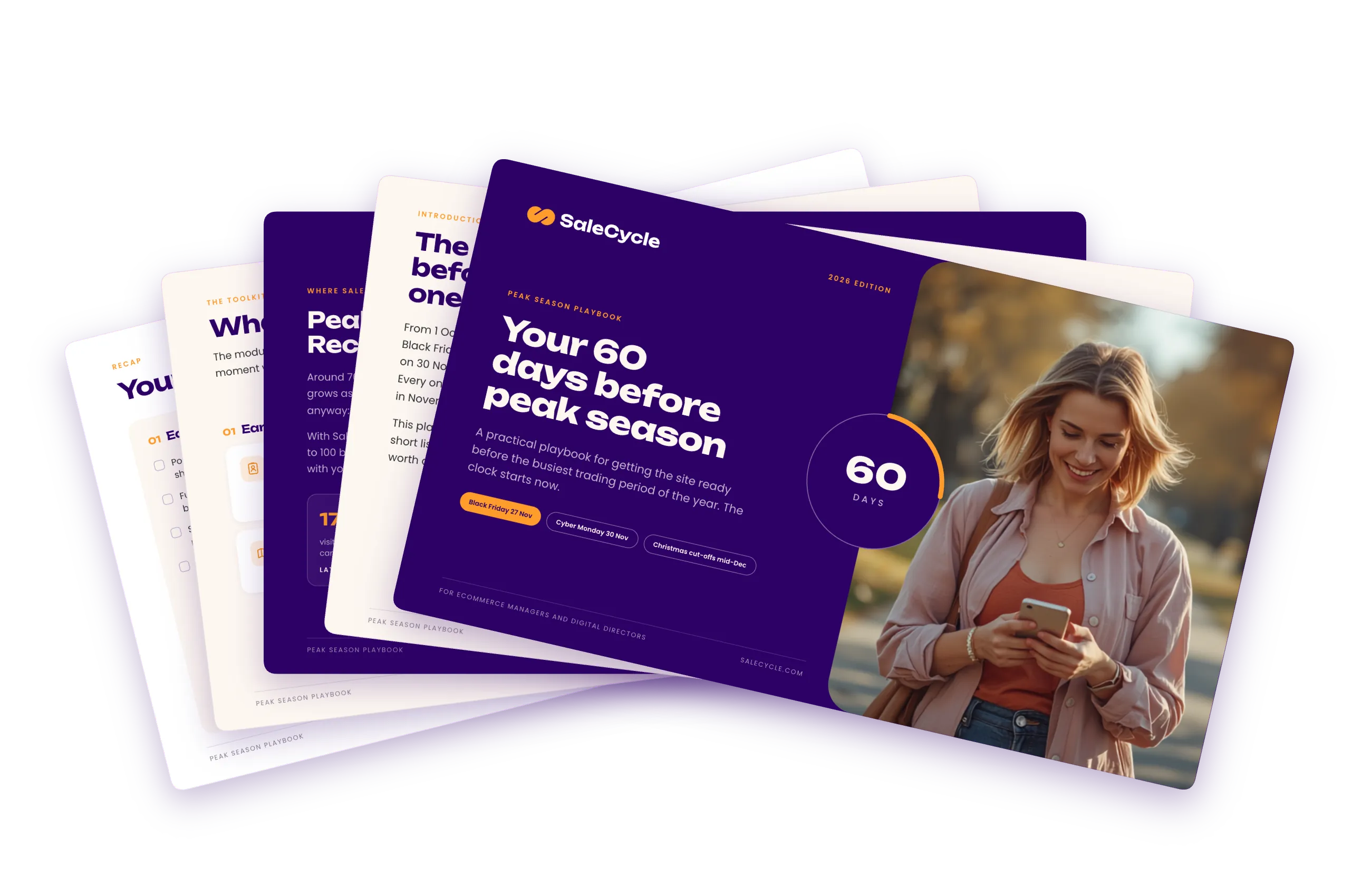
Your 60 days before peak season

Your 60-day roadmap to peak season readiness

You can still get peak-ready in the 60 days from 1 October: audit the funnel and last year's failures in early October, fix, launch and rehearse changes in late October, then freeze the site and focus on trading through November. Every fix costs more the closer it lands to Black Friday.

‍

‍

Here's what you'll learn:
‍

  • A phase-by-phase plan for the 60-day run-up to peak: what to measure in early October, what to fix and launch in late October, and what to freeze in November before Black Friday on 27 November.
    ‍
  • Where each SaleCycle module earns its place across the 60 days, from identifying anonymous visitors to recovering the sales your peak traffic has already cost you.

Early October is for auditing, not guessing. Use the first fortnight to pull last year's funnel data by device and market and find where shoppers actually dropped off. Most visitors never log in, so treat that as a blind spot: identity resolution recognises anonymous traffic, giving a fuller picture than session analytics alone before you plan any fixes.
‍

Late October is for fixing, launching and rehearsing, not shipping new features. Test checkout on a mid-range phone at full network speed, not just desktop. Fix the single highest-drop step first, then run through a bad-day scenario with a named on-call rota. Real-Time Personalisation lets ranking and messaging adapt to live intent once the basics hold.
‍

November is for trading, not building. Lock down checkout and payment code, since nothing should change there unless it's a genuine fix, while content, offers and messaging can keep evolving. When shoppers abandon carts anyway, Multi-channel Remarketing brings them back by email, SMS, WhatsApp and RCS, sequenced so no one is chased across every channel at once.

Download the guide today!

What our clients say

Breitling logo
"Partnering with SaleCycle has been a valuable step in our digital strategy. Their solutions, especially the abandoned cart and remarketing tools, have helped us better engage with and convert visitors who were previously anonymous."

Julia Canas


‍CRM & Customer Journey Manager, Breitling
How Breitling identified visitors and grew online sales →
ARTHUR logo
"By delivering the right message and the right product at exactly the right moment, we've significantly improved the shopping experience  and the results speak for themselves."

Emilie Baraibar

‍Digital Director, ARTHUR
How ARTHUR boosted conversions with on-site personalisation →
Loccitane brand logo
"From the beginning we knew we needed a solution to identify users who were not logged in or out of our database and impact them with a campaign to recover those abandoned baskets. SaleCycle presented us with a clear, simple solution with ongoing support to optimise results."

Rebeca Matías Gonzalez


‍Head of Digital Marketing & e-commerce, L'Occitane
How L'Occitane recovered abandoned carts →

See what SaleCycle can do for your site.

We'll show you on your live site: how many visitors we can identify, how much revenue you're leaving on the table, and exactly where to start.
Book a demo

Commonly asked, quickly answered

We've answered the most common questions below.
When should ecommerce teams start preparing for peak season?
Start now: the 60 days from 1 October are enough if you split the run-up into three phases. Audit the funnel and review what went wrong last year in early October, fix, launch and rehearse changes in late October, then freeze the site and focus on trading through November. Every fix costs more the closer it lands to Black Friday.
What should we fix first before peak trading begins?
Start with the step in your funnel where you lose the most people. For most ecommerce sites, that's the cart stage. Audit drop-off by device and market, fix the single highest-drop step in checkout, and test it on a mid-range phone at full speed rather than just on desktop.
How can we recognise and engage anonymous visitors during peak season?
Most shoppers on an ecommerce site never log in, and that share tends to grow once new peak traffic arrives. First-party identity resolution recognises them anyway, without relying on third-party cookies, so personalisation and engagement tools can act on real visitor behaviour instead of guesswork.
Should we run one discount for everyone during peak season?
No. A blanket sale gives margin away to shoppers who were going to buy anyway. Real-Time Personalisation lets ranking, recommendations and on-site messaging respond to live intent instead, so a nudge only reaches visitors showing genuine purchase intent, while everyone else is simply left to browse.
When should we freeze the ecommerce site before Black Friday?
Lock down checkout and payment code in November: nothing changes there unless it's a genuine fix. Content, offers and messaging can keep evolving, but new integrations should wait until January. Rehearsing a "bad day" in late October, with a named on-call rota, matters more than shipping late features.
How does cart and browse abandonment recovery work across channels?
Onsite Engagement catches visitors before they leave, timed to their intent rather than a fixed delay. Multi-channel Remarketing then brings them back afterwards by email, SMS, WhatsApp and RCS, sequenced so the same shopper isn't chased across every channel at once.